Tuesday, September 23, 2014
Britain and the Piltdown Man
This discovery which originated in 1912 revolved around the supposed "missing link" discovered by Charles Dawson. At the time the term missing link used to give an explanation of the skulls distinct resemblance to man and ape. While today we know that these species are actually ancestors the time frame and the recent findings in Germany and France is what led to the events surrounding this "being". The skull itself was actually the jawbone of an orangutan and the cranium of a man, a medieval man to be exact. The discovery which was at the time so praised and talked about found out to be a fraud by the technology not available during their time. When the skull was first uncovered in East Sussex England Charles Dawson had claimed to have found the ancestor everyone believed to be the connection between humans and ape. The human element of this story, emotions such as pride and greed is what led to it's being praised for so long. Many scientists those of course who were not from Britain had claimed the skull was falsified but due to the lack of evidence could never prove it. In 1953 however when we are able to determine the species and age of fossils it was proven to be a hoax. Carbon dating and a curious mix of chemicals which provided the skull with it's age is how the found it to be fake. Also with the help of microscopic analysis they were able to find file marks on the lower teeth, proof that the jaw been altered in order to fit the idea this species was omnivorous. I feel this example is a perfect reason why scientists need to constantly test and confirm with other scientists. Humans by nature do make mistakes and it sometimes takes more than one person to find the answers. We can't simply remove human from science as we are the ones able to ask the questions like why and how. A machine can only give us the answers but not the questions.

Wednesday, September 17, 2014
Primate Diets
Primates mainly the ones I'll be covering for this post, Lemurs (Prosimians/Strepsirhini), Spider Monkey (New World Monkey/Platyrrhini), Baboon (Old World Monkey/Cercopithecidae),Gibbon (Lesser ape/Hylobatidae), and Chimpanzee (Great ape/Hominidae) live in a wide range of habitats. They each adapt to live in those environments. Some have developed longer arms, stronger jaws, and even the use of crude tools. All this comes about in the search to satisfy the most basic of instincts, to feed.
The area in which which of these apes are found greatly influences their diet. For the most part primates have the base food source of fruit, nuts and plants. While some prefer to eat only those items many in times of scarcity or starvation will turn to eat wide range of items. These items include but are not limited to insects, small vertabrates, birds, eggs, smaller primates and in some cases such as the baboon will even consume large prey items such as goats or sheep. For example Lemurs which can be found exclusively on Madasgascar can and will eat bark and sap. The climate in this forest like most is very hot and humid. Only allowing certain times when a particular fruit or nut can be found.

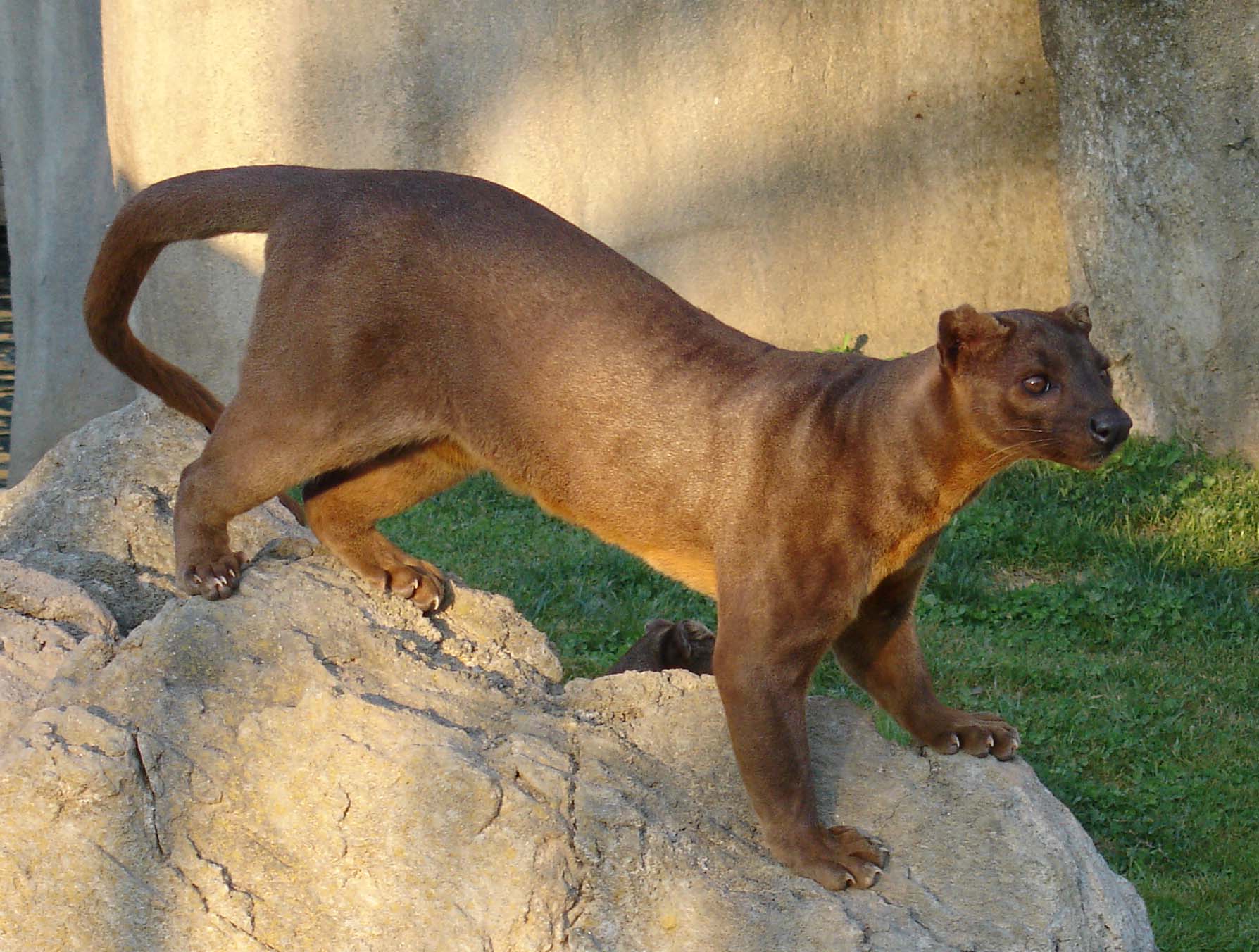
This lemur for example has decided to eat some leaves. Being fast both on the ground and in trees allows them to forage for insects and plants safely without the fear of being caught by predators. They move in bounding motion and quickly hop back into trees and away from danger. A luxury not all can afford. It also helps that being located on an island they do not have many natural predators aside from Fossa seen below.
Spider monkeys which are identified by their long dexterous arms live in forests which include high tree lines and the use of the long arms are suited perfectly for that life. Unlike lemurs spider monkeys spider almost all their time in the trees and being able to move fast is key specially since they prone to stay in the canopy where trees are spread further apart.The arms also help them gather insects and fruits from normally out of reach branches.

Baboons which are considerably the most aggressive looking primate on the list are found in Africa. Which also happens to be inhabited by large predators such as lions and hyenas. The development of the those long canines serve a more defensive purpose. It enables the baboon to scare off most that would them an easy meal. This doesn't mean the Baboon uses them purely for that purpose. The long teeth also help it eat a more diverse prey item like antelopes and herd animals. Compared to the other four these prey items are by far the most out of the way.

Gibbons which considered the fastest primates when it comes to locomotion prey on a majority of the smaller food items found in the primate species. However their speed allows them catch tougher items such as birds. This is due to the unique joint in their wrist which continuously dislocates and relocates with each swing.

Thursday, September 11, 2014
Week 3 Post
Homologous the trait which is carried by the common ancestor and passed down can be seen in many reptiles. Particularly monitors and crocodiles. Like how the beak of each bird is suited to its diet so is the mouth of reptiles.


For the representation of the analogous trait I chose to show Crickets and Honeybees. Using crickets as feeders you witness some pretty interesting behavior, particularly when they eat. Plus I find it rather adorable. The traits in question are the development of the antennae and mouth of these two insects. A crickets antennae have evolved into long thin strands that the insect uses to warn off other males and sense females.

The mouth of a cricket, which unfortunately I couldn't get a closer image of is made for biting and chewing. Since unlike bees they are omnivores and will consume most organic matter, like plants and other weaker crickets.

The honeybee which has shorter antennae uses them along with "dance" and pheromones to communicate with others in the hive. The use is more complex as is the bees social interactions. It's mouth is developed to drain nectar from.
Rhyniognatha hirsti was the first known insect and it appeared about 400 million yaers ago. Although this insect is considered to be the first of the flying insects it also has a mandible. The trait both these species share. So it could be said that somewhere along the line of crickets was a decendent with that trait as well.
Thursday, September 4, 2014
Code Assignment
Here you go! Excuse me if I mistakenly misspelled something. I had a hard time keeping track of the letters.
ATTGTTAGCAAACGCTAGTGCCAATATACCCGCCG
Subscribe to:
Comments (Atom)