Tuesday, October 14, 2014

Solar Radiation and Cultural Adaptation


   Solar radiation or sunlight is electromagnetic radiation given off by sun. It comes in the spectrums of Infrared, Ultraviolet, and visible light. Ultraviolet being the type that is harmful to humans as it is not fully absorbed by the ozone layer. There many sub types of Ultraviolet or UV light but the commonly known to the public are Ultraviolet A (UVA) and Ultraviolet B (UVB). UVB has been known to cause sunburns and eye (cornea) damage but prolonged exposure can cause cancer, particularly of the skin called Melanoma. UVA while harmful has a lesser chance of causing harmful effects. Ultraviolet can also cause damage to our DNA and RNA. The effects of sun exposure can be seen below.
Eye damage resulting from UV exposure can sometimes result in a condition referred to as snow blindness or welder's flash. It is a result of a sunburn on the cornea and other damaged areas. 

Defense from both UVA and UVB rays comes in a variety of forms, as humans have become relatively good at negating the it's harmful effects. 


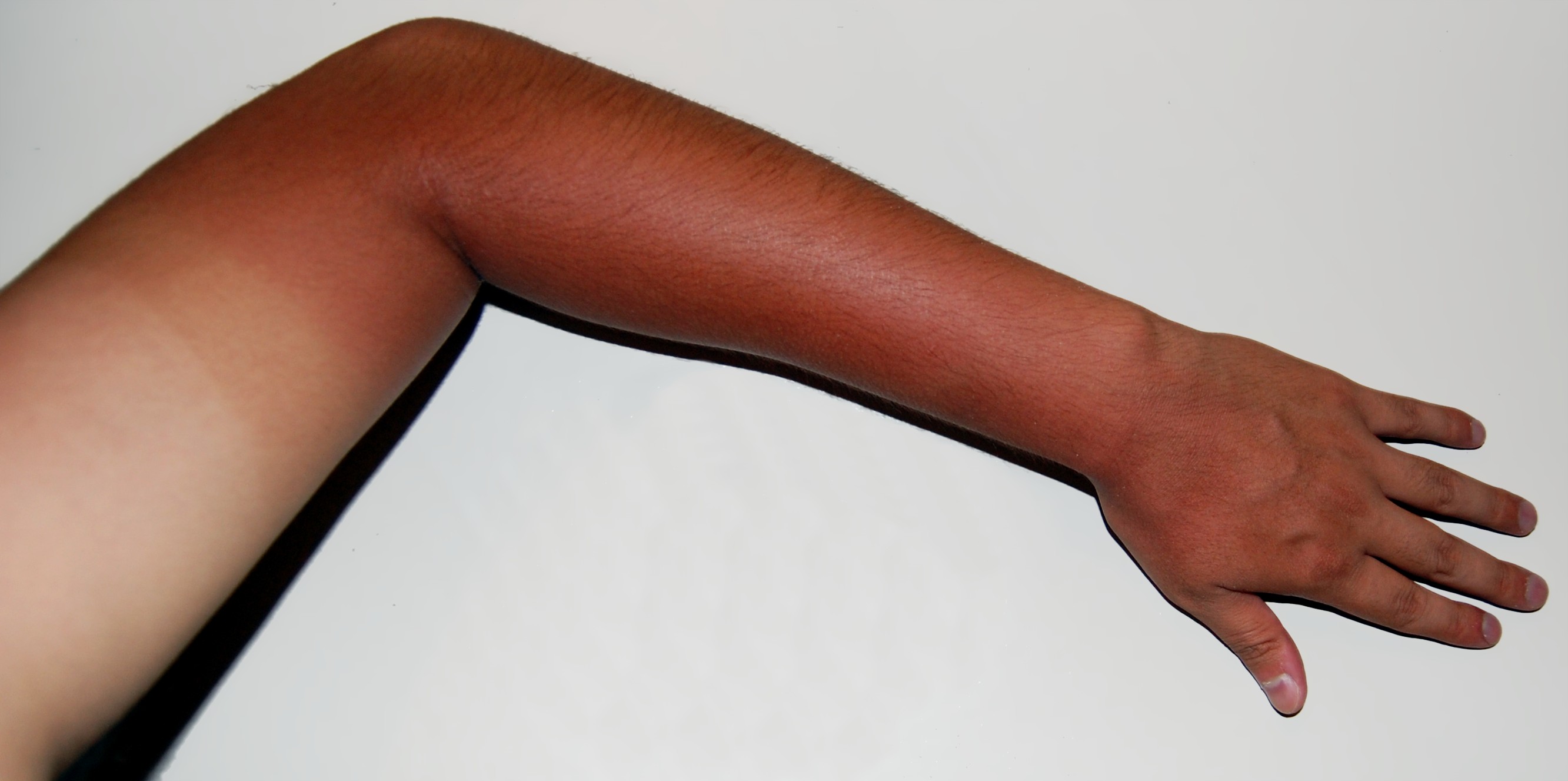
A falculative-term adaptation to this problem comes in the form of tanning. As we lack the protection most animals have from the heat/radiation effects, our skin has developed a quick interesting method to protect itself. The skin will produce melanin a chemical which causes us to tan meaning our skin darkens. With this defense we are able to effectively decrease the amount of UV that our skin absorbs. The tan will exist so long as the UV exposure is present, eventually the tanned skin is pushed to the top layer and peels off, resulting in only a temporary solution.  This process also varies from person to person. Individuals with darker skin don't need to tan, and people with lighter skin may not tan effectively and get sunburned. 

While this image on the left is an example of the difference in tanned skin, it also shows the limitless nature of human creativity.

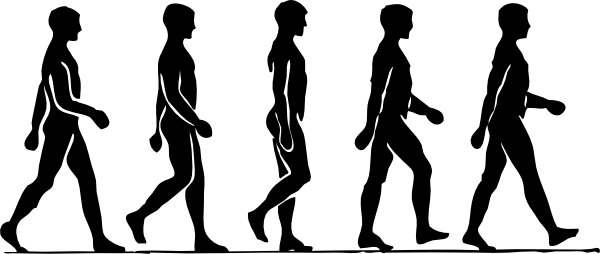
The developmental aspect of UV protection will be familiar to those in this class. Which is the ability to walk upright or be bipedal.  Without the former protection of fur that our ancestors once had our  skin is more exposed to the harmful UV rays (which was
given up to help us better regulate our body temperatures combined with sweating). In essence walking upright limits the amount of surface that is exposed to the sun thus protecting vital parts of the body from harm. This process as we learned took millions of years but our modern form of locomotion is a result of combined evolutionary traits.

Interestingly it would seem the best method to decrease UV exposure would be to wear concealing clothes, however our culture has gone in the opposite direction in response to the heat emitted and for the sake of being attractive. However we still remedy this problem through the use of sun block or sun screen. It can come in spray or lotion form and when applied decreases the amount of UV absorbed by the skin. Even though the purpose is to protect our skin each lotion is different and may only protect against UVA rays and not UVB. Thus the labels of full spectrum and broad spectrum and the SPF factor.

The importance of studying these aspects can help further our understanding to better protect us and help develop better forms of defense. Each environment has different methods as the varying level of ozone and sun exposure varies as well. It provides a perfect opportunity to study the varying effects under different conditions. 

Within each race is also a difference in culture. For example the humans who reside in the arctic have darker skin tone, but with limited sun exposure why and how do they cope with this? Africans also have darker skin but are exposed to much more sun. Simply studying it from a racial aspect would not yield adequate results. Although when we look at it from an environmental perspective we see that the arctic people have darker skin in response to reflection of UV/Sunlight on the ice.  Race also is so varied it is almost sometimes impossible to tell the race of a specific person.


Tuesday, October 7, 2014

Language Post


I have to say this was one of the more interesting assignments for this class, and it was fun to do as well!


  For the first portion we were asked to communicate with someone using no words, writing or ASL.  I had 2 friends help me out on this and they described it as being sort of complicated. I had to agree it was easy to gesture a basic idea of what I was trying to say but detailed of specific thoughts were complicated. Easy gestures such asking for an item  and/or pointing to things was the base of my means of communication.  They way they began talking to me was changed as well, they began to speak slower and simpler. It was almost if they felt I had no idea what they were saying at all. I think maybe it was because since my range of communication was limited they changed theirs as well. I can imagine this same scenario happening between cultures as well. A more "advanced" culture may be more inclined to treat the other as if they whatever reason had lower intelligence. However I noticed this occurring among people who speak different languages as well. It seems to be a desire to be understood, so speaking slower and clear may allow the other person to piece together a basic idea of what message they are trying to convey.

 Part 2 of this weekends assignment involved the lack of gestures and vocal changes. Now this part i found to be more difficult than the 1st. I personally use a lot of hand gestures when speaking, and not begin able to change the tone of my voice took some work. It was easier for them to understand me of course but as for the tone of my message they were unable to decipher it. They couldn't tell if I was being serious, happy, upset or any other emotion. One of my friend's decided to take a turn trying this as well and they  had issues with not being able to gesture using facial expressions. We all established that facial expressions were the most basic form of expressing emotion. Since other animals such as dogs use facial expressions to communicate it can also be considered somewhat necessary. Baring teeth as a form of warning can be very useful. As far as situation with no body language I can't really think of any. I mean even reptiles and birds for the most use body language so I can't really think of a situation where it would be helpful.

Tuesday, September 23, 2014

Britain and the Piltdown Man


      This discovery which originated in 1912 revolved around the supposed "missing link" discovered by Charles Dawson. At the time the term missing link used to give an explanation of the skulls distinct resemblance to man and ape. While today we know that these species are actually ancestors the time frame and the recent findings in Germany and France is what led to the events surrounding this "being". The skull itself was actually the jawbone of an orangutan and the cranium of a man, a medieval man to be exact.  The discovery which was at the time so praised and talked about found out to be a fraud by the technology not available during their time. When the skull was first uncovered in East Sussex England Charles Dawson had claimed to have found the ancestor everyone believed to be the connection between humans and ape. The human element of this story, emotions such as pride and greed is what led to it's being praised for so long. Many scientists those of course who were not from Britain had claimed the skull was falsified but due to the lack of evidence could never prove it. In 1953 however when we are able to determine the species and age of fossils it was proven to be a hoax. Carbon dating and a curious mix of chemicals which provided the skull with it's age is how the found it to be fake. Also with the help of microscopic analysis they were able to find file marks on the lower teeth, proof that the jaw been altered in order to fit the idea this species was omnivorous.  I feel this example is a perfect reason why scientists need to constantly test and confirm with other scientists. Humans by nature do make mistakes and it sometimes takes more than one person to find the answers. We can't simply remove human from science as we are the ones able to ask the questions like why and how. A machine can only give us the answers but not the questions.

Wednesday, September 17, 2014

Primate Diets


  Primates mainly the ones I'll be covering for this post, Lemurs (Prosimians/Strepsirhini), Spider Monkey (New World Monkey/Platyrrhini), Baboon (Old World Monkey/Cercopithecidae),Gibbon (Lesser ape/Hylobatidae), and Chimpanzee (Great ape/Hominidae) live in a wide range of habitats. They each adapt to live in those environments. Some have developed longer arms, stronger jaws, and even the use of crude tools. All this comes about in the search to satisfy the most basic of instincts, to feed.

  The area in which which of these apes are found greatly influences their diet. For the most part primates have the base food source of fruit, nuts and plants. While some prefer to eat only those items many in times of scarcity or starvation will turn to eat wide range of items. These items include but are not limited to insects, small vertabrates, birds, eggs, smaller primates and in some cases such as the baboon will even consume large prey items such as goats or sheep. For example Lemurs which can be found exclusively on Madasgascar can and will eat bark and sap. The climate in this forest like most is very hot and humid. Only allowing certain times when a particular fruit or nut can be found.
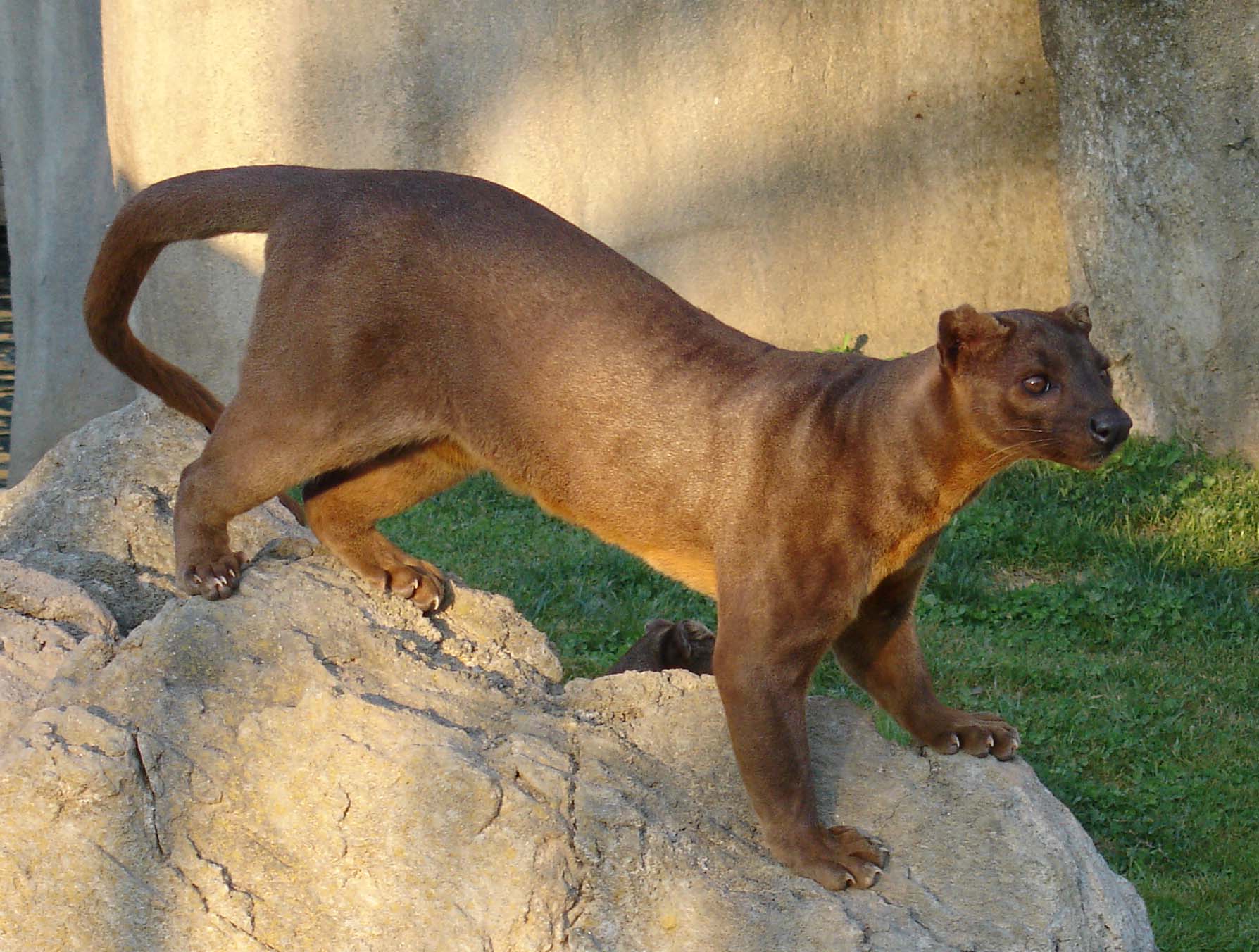
This lemur for example has decided to eat some leaves. Being fast both on the ground and in trees allows them to forage for insects and plants safely without the fear of being caught by predators. They move in bounding motion and quickly hop back into trees and away from danger. A luxury not all can afford. It also helps that being located on an island they do not have many natural predators aside from Fossa seen below.
Spider monkeys which are identified by their long dexterous arms live in forests which include high tree lines and the use of the long arms are suited perfectly for that life. Unlike lemurs spider monkeys spider almost all their time in the trees and being able to move fast is key specially since they prone to stay in the canopy where trees are spread further apart.The arms also help them gather insects and fruits from normally out of reach branches.

  Baboons which are considerably the most aggressive looking primate on the list are found in Africa. Which also happens to be inhabited by large predators such as lions and hyenas. The development of the those long canines serve a more defensive purpose. It enables the baboon to scare off most that would them an easy meal. This doesn't mean the Baboon uses them purely for that purpose. The long teeth also help it eat a more diverse prey item like antelopes and herd animals. Compared to the other four these prey items are by far the most out of the way.
Gibbons which considered the fastest primates when it comes to locomotion prey on a majority of the smaller food items found in the primate species. However their speed allows them catch tougher items such as birds. This is due to the unique joint in their wrist which continuously dislocates and relocates with each swing.

Thursday, September 11, 2014

Week 3 Post


 Homologous the trait which is carried by the common ancestor and passed down can be seen in many reptiles. Particularly monitors and crocodiles. Like how the beak of each bird is suited to its diet so is the mouth of reptiles.
 Both reptiles use their jaw strength to initiate in a maneuver known as the death roll. It is performed by clamping their jaws shut around the intended target and completing a number of rolls to tear of chunks for consuming. While the larger more powerful crocodile has perfected this technique in the form of its large interlocking teeth, the monitor must use this move to take down larger prey or simply stun its victim.  The difference in teeth structure is what has changed due to their hunting environment and prey. As previously stated a crocodiles large are more suited to its large prey and also helps to grip the animal as it is dragged to the water. The monitors diet consists of a wide range of items, including plants and fish so its teeth wouldn't have to be a large. The common ancestor which had the selective traits of scales, skeletal arrangement and muscle came from the amphibians and were known to eat small fish. This would suggest they would have had the same sharp teeth in order to hold on to fish.


   For the representation of the analogous trait I chose to show Crickets and Honeybees. Using crickets as feeders you witness some pretty interesting behavior, particularly when they eat. Plus I find it rather adorable. The traits in question are the development of the antennae and mouth of these two insects. A crickets antennae have evolved into long thin strands that the insect uses to warn off other males and sense females.
The mouth of a cricket, which unfortunately I couldn't get a closer image of is made for biting and chewing. Since unlike bees they are omnivores and will consume most organic matter, like plants and other weaker crickets.
 
The honeybee which has shorter antennae uses them along with "dance" and pheromones  to communicate with others in the hive. The use is more complex as is the bees social interactions. It's mouth is developed to drain nectar from.

 Rhyniognatha hirsti was the first known insect and it appeared about 400 million yaers ago. Although this insect is considered to be the first of the flying insects it also has a mandible. The trait both these species share. So it could be said that somewhere along the line of crickets was a decendent with that trait as well.


Thursday, September 4, 2014

Code Assignment


 Here you go! Excuse me if I mistakenly misspelled something. I had a hard time keeping track of the letters.


ATTGTTAGCAAACGCTAGTGCCAATATACCCGCCG

Thursday, August 28, 2014

Alfred Russel Wallace


  Select one of the five individuals listed above who you would argue had the most influence over
Darwin’s development of his theory of Natural selection. This could be a positive or a negative
influence.


Alfred Wallace could be considered both a positive and negative effect on Darwins life and research. Darwin was driven by Wallace to publish his findings for fear he would lose credit for the theory of natural selection and it would be given to Wallace. He gave Darwin the competition he needed to move forward. 


Briefly (but completely) describe the contribution this individual made to the scientific community. 
You must provide one link to an online source of information besides your textbook. No Wikipedia 
sources! ( 10 pts)

Wallace had similar theories to Darwin regarding natural selection and provided Darwin with birds from his travels.

http://evolution.berkeley.edu/evolibrary/article/history_14


From the bullet point list above (under “How does evolution work?”), identify the point (or points) 
most directly affected by this individual’s work and thoroughly explain how this point was 
influenced by your selected individual. Again, this could be a positive effect, meaning Darwin built 
upon the knowledge this information provided, or a negative effect, meaning that Darwin 
demonstrated that this individual’s idea(s) were incorrect and the mechanism of natural selection 
was an alternative explanation. (10 pts)


In order for traits to evolve and change, they MUST be heritable. 

In order for natural selection to occur, reproduction MUST occur! 

Although his theories were similar they also solidified that reproduction must occur in order for a species to change or evolve. With the selection of desirable traits a species had more chance to pass them on to newer generations.

Could Darwin have developed his theory of natural selection without the influence and ideas of this 
individual? Explain. (10 pts)

Darwin develop the theory without the help of Wallace. It was only after he was faced with the realization that wallace may recieve credit did he choose to publish his findings.


How did the attitude of the church affect Darwin and his eventual publication of his book On the 
Origin of Species? (10 pts)


Darwin remained seperate from the church well aware of its beliefs and practices. However after the publishing of his book the idea of evolution has slowly shifted within the church.